
Overview
During this project, I worked with a group towards a concept for more sustainable housing at the Papaverweg in Amsterdam North. I was focused with another student on the material aspects of the concept. I specifically worked on creating a 3D model containing the new housing situation and the Life Cycle Analysis model used for comparing impacts of materials.
Eventually – with the use of sustainable building principles – we created a more sustainable solution, while still ensuring comfortable housing. I particularly enjoyed working with sustainable materials, creating creative solutions and integrating these with water management and energy aspects.

Experience

3D modelling in SketchUP
I got familiar to working with SketchUP models as a tool to create housing concepts

Life Cycle Assessment (LCA)
I used a simple life cycle assessment model involving shadow cost to calculate the overall sustainability of the concept

Vision creation
Using visual skills from industrial design, I created a vision for the group, which can be seen above
Results
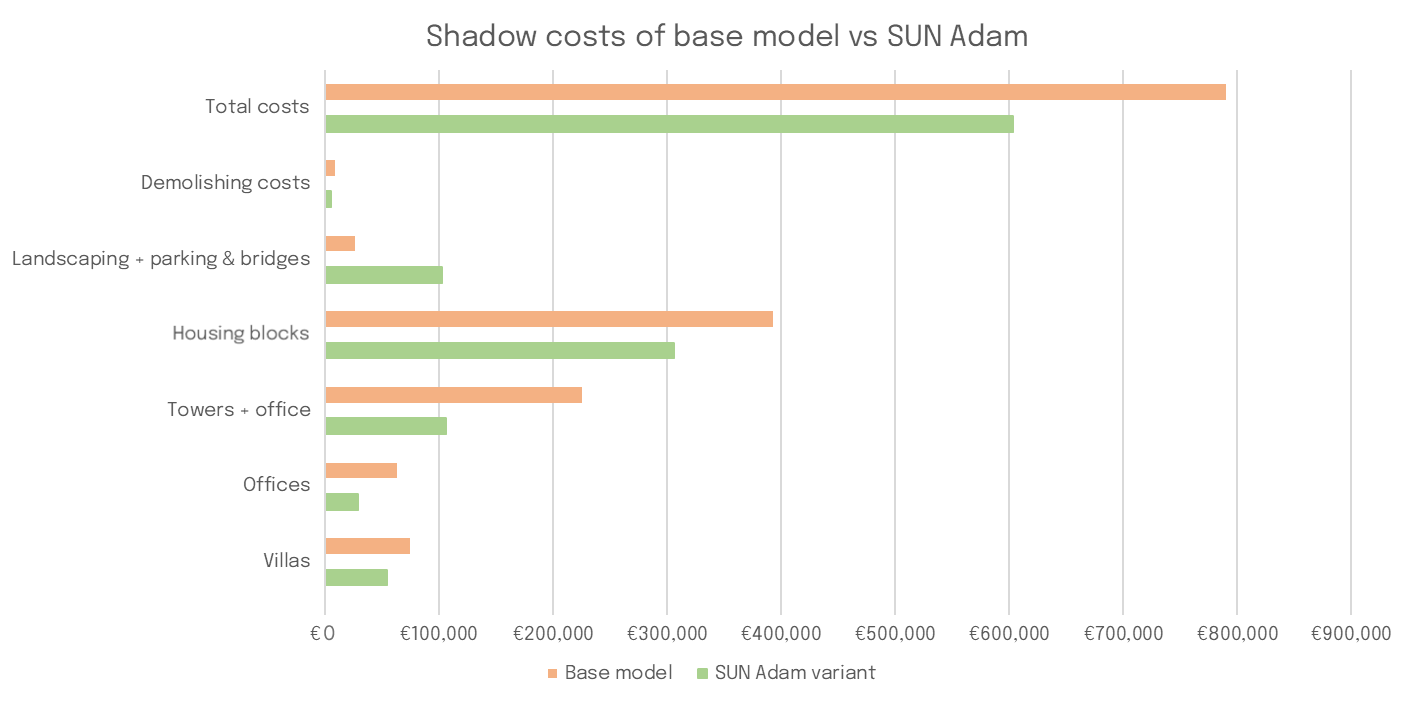
As you can see, the shadow costs are about a fourth lower in terms of shadow costs. Without implementation of measures to improve water management and the impact of energy, the results would have been much lower. Yet, there was a need for a large area of green space to match the vision and for future-proof water management.
This meant that instead of asphalt parking lots, a more impactful concrete parking building was created. Similarly, low apartment buildings were replaced with taller housing blocks. A particularly effective method to reduce the footprint turned out to be the introduction of new materials and recycled materials (especially recycled concrete).
Below, you can see 3 Sketchup models in the slideshow. You can see that there is a lot more green space in the SUNAdam version than in the base model, and the roofs are covered with solar panels or greenery for water management. Also, water is further integrated through a stream with a mill.
3 of the buildings have been directly reused: a large industrial hall, a hall with curved roofs and an old red transformer building. Especially maintaining the industrial hall ensures that the historical nature of the location is maintained.


Our vision to create a liveable, self sufficient and flexible plot implied the following common goals:
Social Goals: Education, Social Cohesion, Comfort, Flexibility, Resilience in the sense of climate adaptation
Environmental Goals: Biodiversity, Efficiency (Decreasing emissions and resource intensity with full self-sufficiency as ultimate goal), Resilience
In the visual below, you can see how different adaptations have contributed to the vision.

Process
The optimal result from a material perspective needed to be constantly adjusted to match the requirements for water management and energy aspects of the concept managed by other teammates, but also comfort and other aspects of the vision.
 Jasmijn Goudsmit